

The senior living customer journey is not a linear path. We are not selling socks! Families are not searching, clicking, and buying all in one web session.
The senior living customer journey can be a long and varied process for families. Depending on the event prompting families to search for senior living, the sales cycle can range from less than 30 days to many years.
Most often the journey is starting online. According to WelcomeHome, in 2023, 80% of inquiries came in from online or aggregator channels. Third party aggregators represented 44% of the digital inquiries.
These third party aggregator sites continue to win online in the generation of quality content to serve every stage and audience of the sales journey.
For operators wanting to reduce their reliance on third party aggregator sites, investing in a smart content strategy will support online rankings, social engagement, email follow up, and every sales stage from inquiry to move-in.
For senior living marketers, content helps inform the communications and touchpoints that support the sales cycle.
On average, once a family has made their inquiry, it takes more than 25 touchpoints before making a decision to move. In some cases, we’ve seen data where 46 touchpoints took place before a family made their decision!
What does this mean for senior living marketers?
1.) Before an inquiry happens, customers are going online to start their research – and usually only when the need arises. You need content for all areas prior to inquiry.
2.) Once an inquiry happens, marketing doesn’t stop. Nurturing leads along each sales stage can augment and accelerate the decision process.
3.) Senior living marketers need to continue to find creative and valuable ways to reach families earlier in the journey to position communities as local resources for families, caregivers and seniors who may be considering senior living.
The solution to this in many cases is a strong content strategy designed to support the entire senior living customer journey and the various digital marketing tactics in your marketing strategy.
In this article, we are going to share some tips and ideas for crafting content to support the senior living customer journey. We are going to cover:
- Aligning your audience with stages in the journey
- Five Questions to Ask As You Start Mapping Your Customer Journey
- How to perform a Content Gap Audit for Customer Journey Success
- Five Steps for Creating a Strong Senior Living Content Plan
- The 4 C’s of Quick Content Creation
Plus, we have included helpful resources for senior living marketing teams and leaders.
Audience & Stages Alignment Along The Customer Journey
Every marketer knows we have to start our marketing efforts with understanding our audience personas and how they move through the buying cycle. There can be several ways to consider how you map your customer journey.
For example,
Traditional marketing stages include awareness, consideration, decision, retention, and advocacy.
In the senior living customer journey we often see the customer journey broken down to research, inquiry, tour, follow up, move-in, and resident.
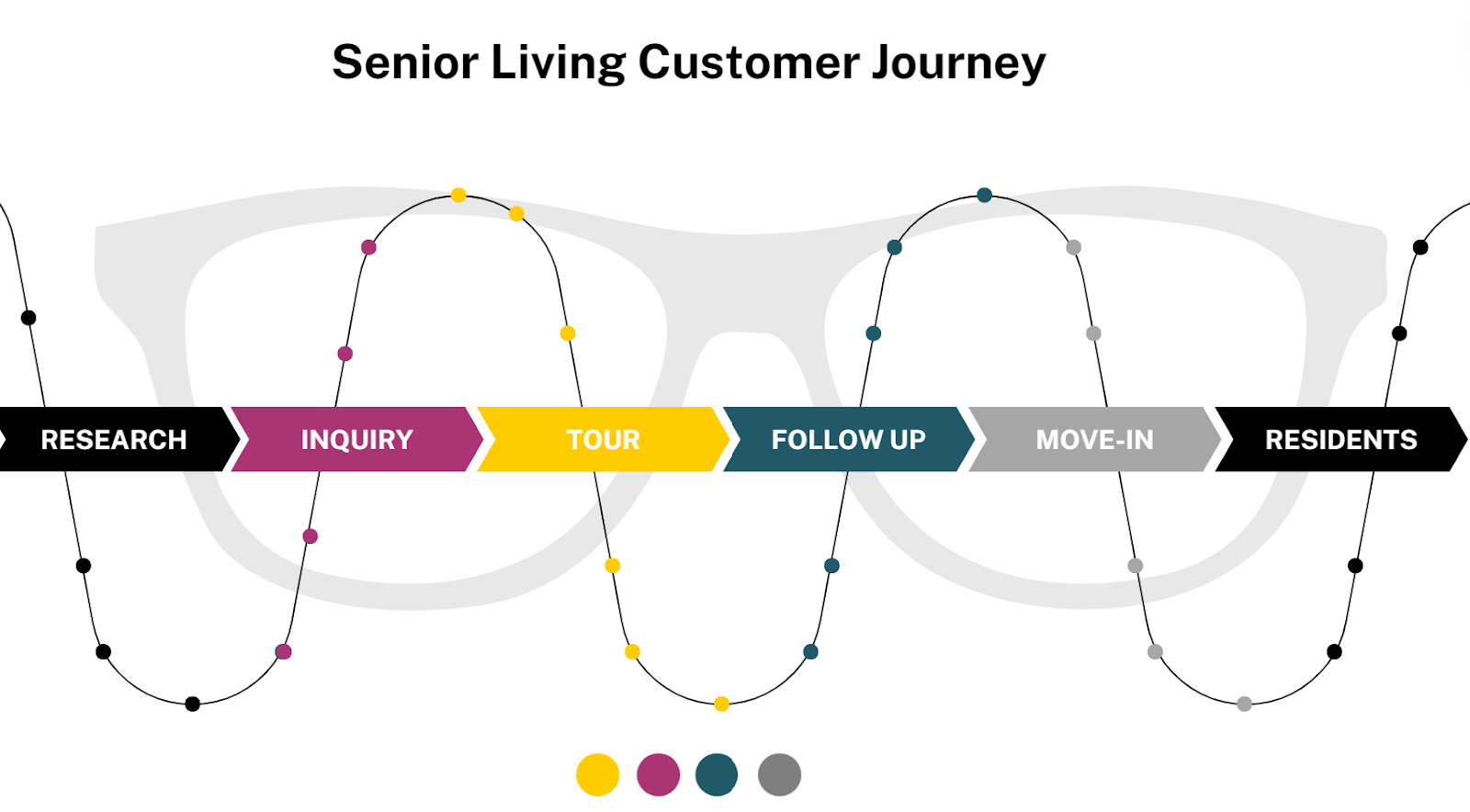
Tour and follow up stages often align with the traditional “Consideration” stage.
Move-in aligns with the “Decision” stage.
Resident stage in senior living often covers the “Retention” and “Advocacy” stages.
So, as we can see not all stages of the senior living customer journey align with traditional stages. The reality is the senior living customer journey starts earlier and goes deeper than any one singular linear path.
Your community’s customer journey should be uniquely mapped to your audience and your service lines.
So, for senior living marketers, there will be several customer journeys to consider when developing a digital marketing strategy plan.
Primary Audience Types:
- Prospective Resident looking for themselves
- Adult Child Influencer looking for a loved one
For each audience type, a journey can be crafted based on the level of service or care that is needed:
- Active 55+
- Independent Living
- Assisted Living
- Memory Care
When we approach creating content for our customer journey, we want to consider each combination of the audience and service type along with the following elements of the prospective families journey.
Five Questions to Ask As You Start Mapping Your Customer Journey
Consider these 5 sets of questions as you start to breakdown your customer journey for each audience:
First, where is the customer along the journey – awareness, consideration, decision, retention, or advocacy stages?
Next, what is the customer sentiment for the stage of the journey they are in? How are they feeling? What are they experiencing?
Then, where does this align with the senior living operator’s sales stages (inquiry, tour, follow up, and move-in) fit in with the customer’s stage & sentiment?
And, what are those additional moments where we can show up along the customer’s journey in a way that provides values, supports their sentiments, and helps them move closer to a decision?
Finally, how are we creating meaningful content to support the customer’s journey through this emotional process.
In the next few sections, we will go deeper into how understanding these sentiments and your own organization’s customer journey will help you find the areas of opportunity for content creation, curation, and support throughout the entire path.
Content Gap Audit for Customer Journey Success
Now that you’ve started to lay out your audience sentiments along the customer journey, take time to understand what content your organization already has.
Content can be in the form of digital and print materials. The biggest source of content about the features and benefits of community living can be found within your sales process.
Brochures, cost of living sheets, move-in programs, flyers, pamphlets, and other printed collateral is a deep source of content knowledge about the product and services you are offering at your location.
Digitally, most websites have similar information organized for families aware of their need and in the research phase.
But…let’s dig deeper.
Your community content strategy reaches far beyond the standard sales materials already published. In fact, senior living sales processes have really dialed in the collateral needed to take an inquiry through a tour and beyond.
We won’t focus much on the content strategy needed for the sales process.
Instead, let’s focus on the marketing content strategy to serve families prior to an inquiry or post a move-in.
Start by looking at the other types of content your community is creating. This content can include your social media posts, email marketing campaigns, event flyers and local outreach materials…and on, and on.
Much of the content we see is focused heavily on the consideration and decision phases of a customer journey – bottom of the funnel research content that hopefully inspires a loved one to inquire.
However, focusing solely on the consideration and decision phases, leave open opportunities for third party lead aggregators to fill in the gaps for the stages earlier in the research phase.
To do this content audit and gap analysis, look at the types of materials, content, and resources your organization is already creating, designing, writing, or publishing.
- Make a list of this content.
- Organize an internal content library.
- Identify which stage of the journey each piece aligns with.
(…its okay if existing content aligns with a couple stages of the journey…)
We’ve created a content library template that lays out the senior living customer journey organized by audience and care level with area for you to expand on the customer sentiments at each stage.
Creating a Strong Senior Living Content Plan
Now that you have an understanding of your audience, the different stages of their journey, and a library of your organization’s content, it is time to start creating your senior living content.
Here are the 5 steps to creating a strong senior living content plan:
Step One: Define the type of content, audience and stage you are creating for
Your content audit should be able to guide your decisions for defining the content, audience and stage you are creating for. Note where you have gaps and how filling that gap with quality information will impact your customer’s research and decision making process.
Step Two: Create a content calendar that is reasonable and manageable
Your content calendar can simply align with other areas of your marketing plan. Perhaps some of the same content themes needed can support the types of on-site events you host, the types of tools or checklists you create, or the dates to give your newsletter and social calendars a boost. Create the schedule with all of this in mind.
Step Three: Work with internal stakeholders or external partners for the development of the content
This step does require an investment of time and resources. A qualified copywriter and graphic designer should be able to capture your brand voice to produce quality content for your plan. Additional consideration should be given to your SEO efforts, keywords, and third party resources to reinforce your own content authority.
Step Four: Publish your content according to your calendar
With your content pieces created, publish according to your calendar. Whether you are printing materials, publishing on your website, posting to social media or sending an email announcement, this step releases your content to the world. Tools for scheduling your content will help streamline this step in your content development plan.
Step Five: Syndicate & repurpose your content across all channels
Now that your content is live, don’t let it live on just 1 channel. Share the content across all channels. Even social media posts that are high value content can be reused on your website or in an email. That printed brochure you invested so much in can be a digital PDF download for families to access from your website. Turn this one new piece of content into multiple pieces.
If you are looking for creative copywriting tips for each stage of your senior living sales funnel, read our blog.
4 C’s of Quick Content Creation
In a recent senior living industry event called Think Tank 2023, the Smart Girl team joined 28 other senior living leaders to have meaningful conversations around making change in the industry.
Part of the work we did at ThinkTank 2023 was to provide a tool to help senior living communities and operators overcome the overwhelm of a strong content strategy. The reality is that no matter how easy we try to make content creation, it is a specialized skill.
Good news…here are 4 ways you can make content faster.
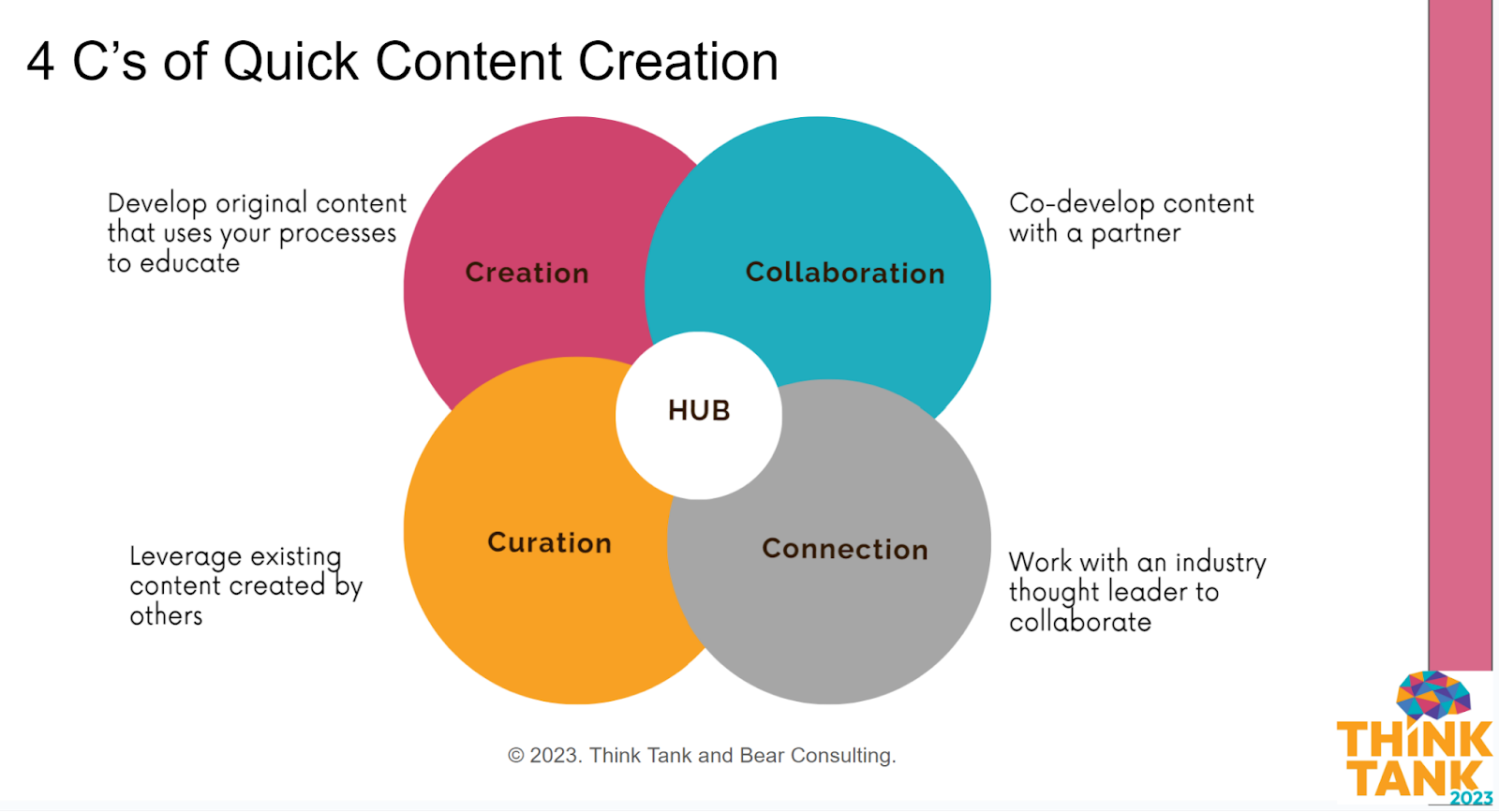
- Creation: Develop original content that uses your processes to educate.
- Curation: Leverage existing content created by others
- Collaboration: Co-develop content with a partner
- Connection: Work with an industry thought leader to connect and share content
Our work at ThinkTank 2023 focused on ReTHINKing the Memory Care Customer Journey: 25 Ways to Level Up Your Dementia Content. Learn more about upcoming Think Tank opportunities.
Finally…Don’t Forget the Human Element of Creating Content
The final note and tip for crafting compelling content for the senior living customer journey is to remember the human element of the people we serve.
Developing content that only ranks better in search engines will disconnect your message and your audience.
Writing content that is only focused on pushing a visit or tour when someone is not ready will lose attention from those earlier in their journey.
Senior living marketing is all about telling the story of your community and the people who make it a wonderful place to live. Your content should reflect this.
Write for humans. Optimize for value to the audience.
For more tips on adding that human element to your sales and marketing, read our blog.
Want More Out of Your Content Strategy?
Let the Smart Girl Digital team help you elevate your content plans. Our client strategies have years of experience working on the operator side of marketing. We specialize in serving senior living communities and their digital strategy.
Book a Discovery Call to learn more.